
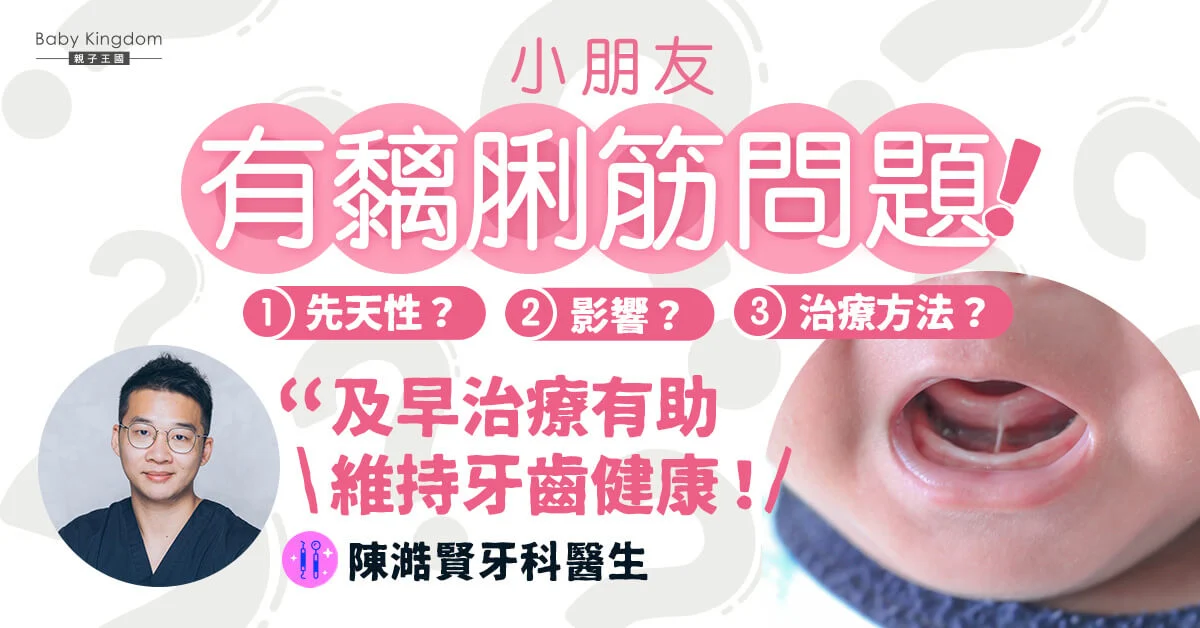
Sticky tongue can't heal on its own? Early treatment in children helps maintain dental health!
Many parents may only discover their child has speech difficulties or sticky tongue after they can speak. However, there are actually signs that can be detected in newborns, and early intervention can prevent further problems! Is sticky tongue congenital? And are there any ways to resolve it? This article deconstructs more information about sticky tongue.
What is a clingy tendon?
"Tongue-tie," also known as frenulum shortening, is a condition caused by an excessively short, tight, or excessively thick soft tissue connecting the tongue and jaw, which restricts the tongue's mobility. It is considered a structural oral problem. Studies indicate that approximately 5% to 10% of infants have tongue-tie.
What are the characteristics of clogged ligaments?
Under normal circumstances, the tongue can press against the upper palate and upper teeth, extending three to four centimeters beyond the lips. However, in patients with frenulum, due to a short frenulum, the tip of the tongue may not be able to touch the upper palate or extend beyond the lower incisors or middle alveolar bone when the mouth is open, limiting the overall range of motion of the tongue. In some patients, the middle section of the tongue may be concave when extended, presenting a heart or W shape. Symptoms of frenulum can be observed as early as birth.
Is sticky tongue a congenital condition? What are its effects?
Sticky tongue is congenital, mainly caused by genetics or a lack of folic acid and vitamins during the mother's pregnancy.
Lingual frenulum is classified into four levels based on its length, position, toughness, and thickness:
The first stage is a heart-shaped tongue, which is more serious and can be detected in infancy. Because the frenulum pulls on the tip of the tongue, it makes it difficult for the tongue to move freely, thus affecting the baby's ability to suckle breast milk or formula, resulting in insufficient nutrient absorption and low birth weight.
Levels two to four, primarily appearing between one and two years of age, not only affect chewing and sucking abilities during eating but also pronunciation, such as alveolar and laminal consonants. Children at this stage are not yet able to eat solid foods, and may swallow food whole without chewing due to sticky palates, potentially causing frequent gagging. Over time, the lack of chewing ability can affect tooth growth and even tooth alignment and the development of the upper and lower jaws.
In addition, because children with ligament sticking to their tongue cannot move their tongue, their tongue cannot effectively clean food debris from their teeth, making them more susceptible to gingivitis or periodontitis than their peers.
Is there a way to get rid of twitching?
Sticky tongue will not heal on its own as a child grows. It is recommended that patients seek medical attention and treatment as soon as symptoms appear. It is also recommended that children have an oral examination starting at age one to ensure that there are no abnormalities in the teeth, frenulum, or jawbone.
Whether or not surgery is needed depends on the severity of the patient's difficulty eating and speech problems.
The common surgical treatment for frenulum is frenectomy, also known as tongue frenulum release surgery, performed by an oral surgeon. Before the surgery, the patient is anesthetized. During the procedure, the surgeon lifts the patient's tongue and uses a laser or electrocautery to remove the frenulum at the base of the tongue. After the anesthesia wears off, the patient can eat, but should avoid hot foods for 24 to 48 hours post-surgery.
Author: Dr. Eric Chan


